Disability Sector Glossary
A plain-English guide to disability, health and NDIS terms
Navigating the disability sector, health services and the NDIS can feel overwhelming. You may come across words and phrases that are unfamiliar, confusing or used in different ways.
This glossary has been created to explain commonly used disability, health and NDIS terms in clear, plain English. It is designed for people with disability, carers, families and supporters.
A
Accessibility
In disability, accessibility means something can be entered, reached or used by everyone, including people with disabilities (for example, buildings with ramps, lifts and accessible toilets).
Accessible
A place, service or environment that people with disabilities can use safely and easily.
Access request
A request to become an NDIS participant. This usually includes forms and evidence about your disability and how it affects your everyday life.
Access requirements / Eligibility criteria
The rules you must meet to join the NDIS. You must be under 65, live in Australia as a citizen or permanent resident, and meet disability or early intervention criteria.
Acquired Brain Injury (ABI)
Brain damage that happens after birth. It can be caused by trauma, infection, stroke, or alcohol and other drug use.
Acute
An illness or condition that starts quickly or lasts a short time.
Adolescent
A young person aged 10 to 19.
Advocacy
Support from a person or organisation that helps speak up for your rights and supports your voice, choices and inclusion.
Advocate
A person who speaks or writes in support of you or your needs.
Allied health / Allied health care
Health care is provided by trained professionals who are not usually doctors. Most have university qualifications. Examples include occupational therapists, physiotherapists, psychologists, speech pathologists and social workers.
Ambulant / Ambulation
Able to walk, or the act of walking.
Ambulatory
Receiving care as an outpatient (not staying in hospital).
Aphasia
Difficulty speaking or understanding language due to damage to the brain.
Aspiration
A hope or ambition to achieve something.
Assessment
When a health professional asks questions and may perform tests or examinations to understand your needs and identify supports that could help.
Assistive technology (AT)
Equipment or devices that help with everyday tasks (for example, wheelchairs, communication devices or shower chairs).
Ataxia
Loss of coordination, such as difficulty walking steadily.
Attention Deficit Hyperactivity Disorder (ADHD)
A condition that affects attention, impulse control and activity levels, which can make it harder to focus, stay organised and manage everyday tasks.
Audiologist
A health professional who specialises in hearing and balance.
Autism Spectrum Disorder (ASD)
Autism is a developmental condition that affects communication, social interaction and sensory experiences. Autism is a spectrum, meaning it affects people in different ways and to different degrees.
Autonomy
Independence. The ability to make decisions and do things on your own.

Wheelchair ramp showing accessibility by allowing people using wheelchairs or mobility aids to enter the building independently.
B
Behaviour support
Support that helps understand why behaviours happen and puts positive strategies in place to improve safety, wellbeing and quality of life. Behaviour support focuses on reducing the need for restrictive practices.
Behaviour support practitioner
A qualified professional who assesses behaviours of concern and develops a behaviour support plan. Behaviour support practitioners must meet NDIS requirements and be approved to work in this role.
Behaviours of concern
Behaviours that may put the person or others at risk, or significantly limit participation in everyday life. These behaviours are often a form of communication and usually happen when a person’s needs are not being met.
Bulk-billing
When a health service bills Medicare directly, you pay nothing or less for the service.
Burnout
A state of physical, emotional and mental exhaustion caused by ongoing stress or caring demands. Burnout can affect carers, support workers and people with disability.
C
Capacity building supports
NDIS funding for therapies and services that build skills, independence and participation.
Capital supports
NDIS funding for equipment, home modifications or specialist housing.
Carer
An unpaid person who provides care or support to someone with disability, illness or who is very young.
Check-in
A conversation with an NDIA planner or NDIS partner to see if your plan is working for you.
Child development
The physical, emotional, social and language changes that happen from birth to adulthood.
Child life therapist
An allied health professional who helps children and families cope with hospital experiences using play and preparation.
Child representative
Someone with legal responsibility for a child under 18 who can make decisions on their behalf.
Choice and control
Your right to make decisions about your supports, providers and how your funding is used.
Client / Consumer
A person who receives a service.
Community engagement
How a person takes part in everyday community life, such as shopping, sports, events and social activities.
Community and informal supports
Support from family, friends, neighbours and community groups.
Community and mainstream supports
Supports available to everyone, not funded by the NDIS (for example, health, education, housing and transport).
Community connections
Help from an LAC or early childhood partner to connect with community and mainstream services.
Confidentiality
Your personal information is private and should not be shared without your permission, unless legally required.
Consent
Permission for something to happen.
Correspondence nominee
A person who can receive mail and make enquiries for a participant.
Criteria (criterion)
Rules or measures used to make a decision.
Core supports
NDIS funding for everyday supports like personal care, transport and social participation.

A man supporting a woman with disability while they relax together on the couch, sharing a coffee — an example of an unpaid carer providing everyday care, companionship and support.
D
Defined program
Government-funded disability programs that existed before the NDIS.
Developmental concerns
Delays in a child’s development that affect daily life but do not meet NDIS criteria for developmental delay.
Developmental delay
When a child does not reach expected milestones and needs extra help with everyday activities.
Diagnosis
Identification of a condition or disability by a qualified health professional.
Dietitian
A health professional who specialises in nutrition and diet.
Disability
A condition or impairment that affects daily life. Under the NDIS it is usually permanent or likely to be permanent.
Disability Pension
A Centrelink payment for people unable to work due to disability.
Disability support worker
A paid worker who provides assistance with daily living and community activities.
Doctor
A medical practitioner who has completed a medical degree and is registered to practise.
Document Verification Service (DVS)
A secure system used to check identity documents, with your consent.
Dysphagia
Difficulty swallowing food or drinks.
Dysphasia
Difficulty speaking or finding the right words.
E
Early Childhood Early Intervention (ECEI)
NDIS supports for young children to reduce the impact of disability early.
Early childhood approach
Support focused on development, learning and participation for young children and families.
Early childhood partner
Local organisations funded to deliver early childhood supports.
Early intervention
Support provided as early as possible to build skills and reduce the impact of disability.
Eligibility
Whether you meet the rules to receive supports.
Equipment
Tools or devices that support independence and safety.

A woman supporting a young girl’s development through play with blocks, showing how early support helps build learning, confidence and participation for children and families.
F
Formal supports
Paid supports delivered by workers or services.
Functional impairment
Difficulties with body function or daily activities that limit participation.
Funding
Money in an NDIS plan used to pay for approved supports.
G
General practitioner (GP)
A family doctor who provides primary health care and referrals.
Goals
What you want to achieve with support.
Global developmental delay (GDD)
Significant developmental delays in two or more areas for children under 5.
H
Hard of hearing / Deaf
Hard of hearing usually means mild to moderate hearing loss. Deaf often refers to people with little or no hearing who may use sign language.
Health
Overall physical, mental and social wellbeing.
Health liaison officer (HLO)
A worker who helps coordinate NDIS supports when someone leaves hospital.
I
Immunisation
Protection from disease through vaccination.
Immunosuppression
A weakened immune system that cannot fight infections well.
Independence
The ability to make decisions and do things on your own.
Inpatient
A person admitted to hospital.
Insurance (NDIS)
The idea that everyone contributes through taxes so people who need support can access it.
Intellectual disability
Difficulty with learning, understanding and problem solving.
Intensive Care Unit (ICU)
A hospital ward for people who are very unwell.
Internal review
A review by the NDIA if you disagree with a decision.
Informal supports
Unpaid support from family, friends or neighbours.

A woman receiving a flu vaccination from a doctor, an example of immunisation that helps protect against illness and supports long-term health.
M
Maternal and Child Health Nurse (MCHN)
A nurse who supports babies, young children and families.
Medicare
Australia’s public health system that helps cover medical costs.
Mental illness
A condition that significantly affects thoughts, feelings or behaviour.
Mental wellbeing
A child’s emotional, social, behavioural and thinking development.
Mentor
A supportive person who guides and encourages someone.
Modifications
Changes to a home, vehicle or equipment to improve access and safety.
Music therapist
A professional who uses music to support wellbeing and health.
Multi-disciplinary
A team made up of different professionals working together.
My Aged Care
The main entry point for aged care services in Australia.
N
National Disability Insurance Agency (NDIA)
The government agency that runs the NDIS.
National Disability Insurance Scheme (NDIS)
A national program that funds disability supports for eligible Australians.
Nephrologist
A doctor who specialises in kidney conditions.
Neurologist
A doctor who specialises in the brain and nervous system.
Nominee
A person appointed to act or make decisions for a participant.
Nurse
A health professional who supports health and provides care.

National Disability Insurance Scheme sign outside the National Disability Insurance Agency office
O
Occupational therapist (OT)
A professional who helps people do everyday activities more independently.
Outpatient
A person who receives care without staying in hospital overnight.
P
Paediatrician
A doctor who specialises in children’s health.
Participant
A person who has been accepted into the NDIS.
Participant statement
A description of a participant’s goals and aspirations.
Pathologist
A specialist who diagnoses disease by examining samples.
Peer worker
A person who supports others using their own lived experience.
Personal protective equipment (PPE)
Protective items such as masks, gloves and eye protection.
Pharmacist
A health professional who provides medicines and advice.
Physiotherapist
A professional who supports movement, strength and physical function.
Physical disability
A condition that affects mobility and physical activities.
Plastic surgeon
A doctor who repairs or reconstructs parts of the body.
Plan
A written NDIS document outlining goals, supports and funding.
Planning conversation / planning meeting
Meetings to talk about goals, needs and supports.
Portal
An online account used to view NDIS plans and budgets.
Prescription (script)
A doctor’s written or electronic order for medicine.
Preventative health care
Health care that prevents illness or injury, such as vaccines.
Primary carer
The main adult responsible for caring for a child.
Procedure
A medical action used to diagnose or treat a condition.
Provider
A person or organisation that delivers supports or services.
Psychologist
A professional who supports mental health and wellbeing.
R
Reasonable and necessary
Supports the NDIS can fund because they are related to disability, fair and needed.
Referral
A request from a doctor for another professional to provide care.
Rehabilitation
Support that helps someone recover skills and independence after illness, injury or surgery, for example through therapy, exercise or training.
Respite
Short-term support that gives carers a break.
Rheumatologist
A doctor who treats joint, muscle and autoimmune conditions.
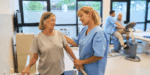
A woman working with allied health professionals in hospital, showing what rehabilitation might look like as she rebuilds strength, skills and independence after surgery related to her disability.
S
Scheme
Another word for program.
Self-management
Managing your own NDIS funding and paying providers directly.
Social worker
A professional who provides counselling and connects people to supports.
Specialist
A doctor with advanced training in a specific area.
Speech pathologist
A professional who supports communication and swallowing.
Subsidised
Partly paid for by the government.
T
Temporary
Lasts for a limited time.
Therapy
Support or treatment to improve skills, wellbeing or function.
Treatment
Medical care for illness or injury.
V
Vaccine
A treatment that helps the immune system fight disease.
Vision impaired / Blind
Reduced or no usable vision that affects daily life.
Z
Zero tolerance
A policy or approach that does not accept abuse, neglect, violence, exploitation or discrimination under any circumstances.
Zone of regulation
A framework used to help people understand and manage emotions and behaviour by identifying emotional “zones” and learning strategies to move between them.
Keep Learning with Lifely
We hope this glossary helps make disability, health and NDIS language feel clearer and easier to navigate. Understanding the words can make a real difference to feeling confident and informed.
If you would like to keep learning, check out Lifely’s other blogs and learning topics for more plain-English information, practical tips and resources to support people with disability, carers and families.
Click here to see our full list of blogs and learning topics.
Click here to read our list of frequently asked questions (FAQs).